I had a good day on Fork, Monday. No big ones but more action than I've had in a while. Caught 7 in the two to three pound range on hollow belly swimbaits real shallow, two on 5 inch flutter spoon in 18 feet of water, and one on topwater. Spent the first three hours of the morning wondering if I would get skunked before finally trying it out deep and getting some action. I was just drifting around timber looking for bait and working it under them. Paddling back upwind and repeating.
Thought I might have done better if I'd stayed with it but it was a beating to fight the wind and have to constantly paddle back into position. Between paddling and getting spoon stuck and fighting waves to get it back with plug knocker it got old fast.. When I finally got hung up and couldn't get it back I was done with that kind of fishing as I only had the one with me. Forgot to put the ones I had just bought that morning at Joe Spaits Tackle Factory, in my kayak.
Covered a lot of water fishing shallow back up Little Caney. Picked up a few scattered here and there but finally found an area with shad swimming around on the surface and caught a couple real quick and lost a bigger one. When I saw an alligator come swimming into the same cove... it was like a sign for me stay put. Didn't get a picture as it went to the other side of the cove when it saw me and I figured I would catch up with it later but it disappeared in the vegetation.
The key for me catching was to only fish around the shad when they came near to shoreline vegetation as it didn't seem like they were getting chased in the middle of the cove. There were three or four schools on top for hours. Wished now that I had stayed longer but kept thinking I should try deep again once the winds laid down later and fished the last two hours of light where I started the day.
No complaints today and I'll be back there next Monday.
Kastking Zephyr BFS Reel delivered yesterday. Was able to take it fishing to the local pond. After a few tweaks was able to cast a 1/16 oz Rooster Tail without issue, even caught a little Bass. Here’s to more fish caught using this BFS reel. More to come from an Average Joe’s perspective on BFS fishing! PS: In keeping with our “Learn to fish by our trials and errors” motto, here are thoughts for this round. LEARN BY OUR TRIALS AND ERRORS Adjust spool tension so the line does not overrun the spool when the lure hits the water. Adjust the magnetic brake to reduce a backlash and shift the casting release point left or right as desired. Windy conditions will impact the cast more than a standard bait casting reel. Be aware when casting into the wind and against the wind. Make adjustments as you change lures and when using lures that soak up water like a Rooster Tail, make them after they have soaked in water. Practice “training your thumb” but take it one ...
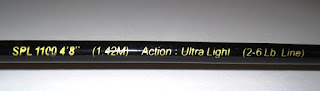
Received two questions from a Reader in response to our post on “How we fish a Super Duper”: “What kind of spinning gear are you using (rod length & power, reel size & make)?” “Do you use a swivel with Super Dupers or Kastmasters?” Below are the answers to the questions and pictures added for ease of reference. Thanks again for your questions! Sincerely, The Field Team For the first question, “What kind of spinning gear are you using (rod length & power, reel size & make)?”, the spinning gear we use are: A 4′-8″ Ugly Stik Ultralight Rod with a Shakespeare 20 Ultralight Spinning Reel (USP225A) 6′-6″ Berkley Medium Light Lightning Rod with a Pinnacle Tiny Deadbolt Spinning Reel(DUL20). Lately, when using fluorocarbon, we have switched the reels between the two rods, and mainly been using the Berkley Medium Light Lightning Rod and the Shakespeare Spinning Reel. The Pinnacle Spinning Reel tends to uncoil while casting ultralight lures after 5-10 casts. Shakespeare ...
Video snippet showing how I switch the Martin Fly Reel from left to right hand retrieve. Works for similar click-pawl drag single action, fly reels. For more details, see the full video Try These Two Modifications for the Martin Fly Fishing Combo !
Answering the mail from a Reader’s question concerning Denison Dam Tailrace and Lake Texoma. Do check it out and do stay till the end for a bonus tip! Also, here is an outline of the info provided in the video for reference. Question 1: Daily limits for Texoma vs. Denison Dam (tailrace) Answer: TPWD 2019 Regulations and ODWC 2019 Regulations Texoma Striped Bass and Hybrid Striped Bass – No Minimum Length – 10 per day per person – Of which two can be 20″ or greater – Culling is not permitted White Bass – No Minimum Length – 25 per day per person Yellow Bass – No Minimum Length – No daily limit Denison Striped Bass and Hybrid Striped Bass – No Minimum Length – 5 per day per person – Culling is not permitted White Bass – 10″ Minimum Length – 25 per day per person Yellow Bass – No Minimum Length – No daily limit Question 2: Suggested Fishing Gear Answer: Varies based on water fl...
Here is a Largemouth Bass Weight Estimator developed by Texas Parks and Wildlife! We modified the table to use a calculator format. Here are the details on how the Estimator was developed: Estimating Weight of Largemouth Bass This information is provided for those who wish to hold “paper” fishing events, releasing bass immediately after catch instead of holding them for weigh-in. Figures in the conversion table below represent average weights calculated from statistics on 3,178 Texas bass. By using this table, you can get a reasonable estimate of a fish’s weight. This method is not accepted for official fish records and will never be as accurate as weighing on a certified scale, but it can be helpful at slot limit lakes, or for fishing clubs that wish to provide better care for bass during the hot summer months when fish are easily stressed. Instructions Measure the bass to the nearest eighth of an inch. Go down the first (left-hand) column and locate the row corresponding to the...
Received a question about how we used cheese cloth when fishing with bread as bait. Below is a brief summary of what how we do this: Form a bread ball with the bread, Then, place it in the middle of a 4″ x 4″ piece of cheese cloth, Next, take two opposing corners of the cheese cloth, pull them together and thread them on to a Circle Hook. Do the same with the remaining corners of the cheese cloth. With all four corners threaded on to the Circle Cook, twist the bread ball covered with cheese cloth around to tighten the cloth. Finally, pass the hook once through the bread ball, not in the middle but more on the side. This will keep it from twisting off. That’s it… Good luck!
Back at the day job, and already have withdrawals from the Texas Hill Country and Texas Coast. Was a fun time last week, now it’s back to the daily grind… but, always can find time for a break with some ukulele time!
This video answers the mail – a YouTube Viewer requested we show the hand hold we used in the video One Rod, No Reel. The intent of the One Rod, No Reel was to show quality fly line was more important than the fly reel, and the suggestion was to focus more on a quality fly line, followed by the fly rod, and then the fly reel for most fishing situations. In One Rod, No Reel, we used a premium but old 5wt WF Fly line that we have since retired… keeping about 8 yards of the forward portion of the fly line, attaching it to a short section of dacron backing, and a rubber band. We then attached the rubber band to the rod handle, and then demonstrated casting without a fly reel as well as catching a trout or two at a local pond. To answer the mail, we removed the 4wt fly reel that was zip tied to an Orvis Practicaster, and used the heavy “rope like” practice line that came with it to show the hand hold used. And since, we still had the fly line used in the One Rod, No Reel vi...
More fun fishing local ponds. This round we go to Angel Parkway Pond in Allen, TX with the OPST Commando Head and 9′-5wt Redington Fly Rod and Echo Ion Reel. Great combo for fishing and matches well with the OPST Commando Head. This round, we demo how we cast the Over The Shoulder Cast The situation calls for casting at time over our off-shoulder side due to trees and lots of brush lining the banks. We start to setup for a cast, but a Bluegill takes the fly. Once we release it, we demo using a Perry Poke to setup the Over The Shoulder Cast. Then, we show a cast where the line lays behind us on grass, followed by a cast where the line lays in front on the water. Finally, we show the Over The Shoulder Cast where a traditional Overhead Cast is used but is basically in reverse casting the line to the spot we want to fish by releasing the line on the back cast. We stand sideways to the target area and basically are casting backwards. Do give it a try some time, and with the OPST Comman...




Comments
Post a Comment